

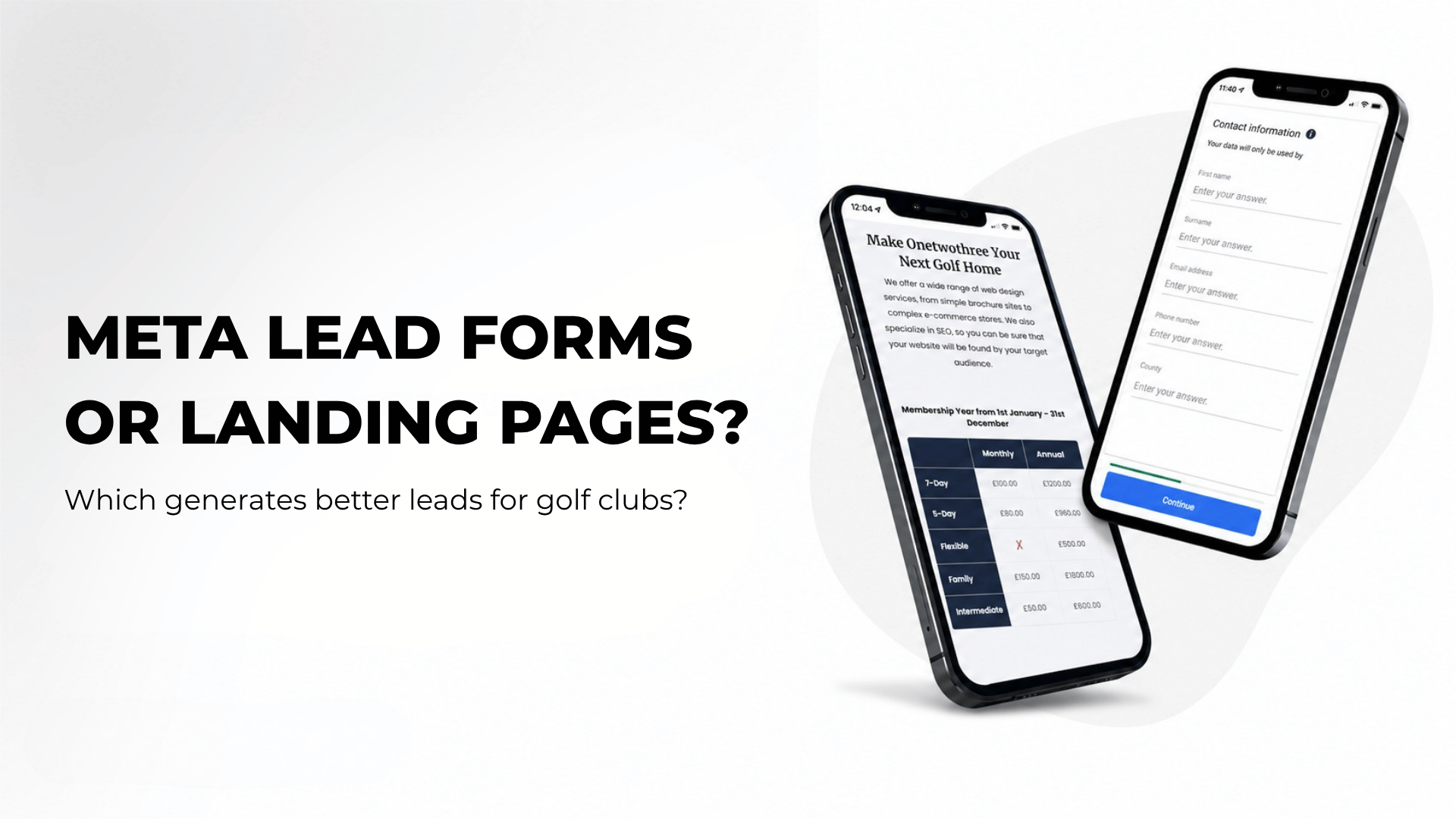
When planning a paid social media campaign, your golf club must decide what happens after someone clicks the advert. Should the advert open a Meta Lead Form inside Facebook or Instagram? Or should it take them to a dedicated landing page?
This may sound like a minor technical decision. However, it can affect the number of leads you receive and the quality of those enquiries. It can also affect how quickly they convert.
Meta Lead Forms often generate more leads at a lower cost. Landing pages usually produce fewer enquiries, but those people tend to understand the offer better. Both routes can work for memberships, societies, golf days, open days and other campaigns.
So, which should your golf club choose? The answer depends on your objective, the complexity of the offer and your follow-up process.
What Is the Difference Between Meta Lead Forms and Landing Pages?
Meta Lead Forms allow someone to enquire without leaving Facebook or Instagram. The golfer sees the advert, clicks the call to action and completes a form within the platform.
Meta may already hold some of their contact details and can add them to the form automatically. As a result, the whole process can take only a few seconds. This makes it easy to register an interest in membership, request society information or sign up for an open day.
That convenience explains why Meta Lead Forms can produce large numbers of enquiries. The golfer faces very little friction and needs to make very little effort.
However, they may have seen little more than the advert itself. They may not have reviewed the membership price, studied the benefits or looked through the society packages. In some cases, they may not have properly considered whether the opportunity suits them.
A landing page creates a different journey. The advert takes the golfer to a page built specifically for that campaign. It gives the club more space to explain the offer before asking for an enquiry.
A membership landing page might include course photography, prices, benefits, testimonials and frequently asked questions. A society landing page could show package prices, catering options, available days and minimum group sizes.
The golfer needs to spend more time considering the information before completing the form. This extra step will usually reduce the number of enquiries. However, it can also remove people who were only mildly curious.
Put simply, Meta Lead Forms remove as much friction as possible. A landing page uses some of that friction to help qualify the enquiry.
What Did We See in a Real Golf Membership Campaign?
We recently ran the same membership advertising concept across two locations operated by one client. Both campaigns covered a two-month period. The main difference was the journey after someone clicked the advert.
At one location, the golfer completed a Meta Lead Form without leaving Facebook or Instagram. At the other, the advert took them to a dedicated membership landing page.
The results were:
| Campaign | Enquiries | New members | Conversion rate |
|---|---|---|---|
| Meta Lead Forms | 443 | 3 | 0.7% |
| Landing page | 75 | 12 | 16% |
The Meta Lead campaign generated 443 form fills and three new members. The landing page generated only 75 enquiries, but 12 of those people joined.
Therefore, the landing page produced 83% fewer enquiries while generating four times as many memberships. Around one in every six landing-page enquiries converted. The Meta campaign needed roughly 148 form fills to produce one member.
The landing-page conversion rate was around 24 times higher.
We should acknowledge that this was not a perfect like-for-like test. The campaigns promoted two different locations. Local demand, membership prices, competition and each club’s reputation may have influenced the results.
Even so, the difference shows why clubs should never judge a campaign by lead volume alone. If we wanted the report to look impressive, we could put 443 leads in a very large font. The 12 new members represent the more important commercial result.
Why Did the Landing Page Enquiries Convert Better?
We asked the same questions on both forms. We did not discover a magic question that turns a casual golfer into a club member.
The difference came from the information around the form. Before enquiring through the landing page, the golfer could see the price, benefits, course and testimonials. They had enough information to decide whether the membership suited them.
If they disliked the course or could not afford the membership, they could leave without enquiring. This reduced the number of form fills. It also meant the club spent less time contacting unsuitable prospects.
The landing page allowed golfers to qualify themselves before the club started its follow-up process.
Why Not Send People to the Main Club Website?
A golf club website needs to serve several audiences. It may include membership information, visitor green fees, society packages, results, functions, club history and contact details.
A campaign landing page has one clear job. Every headline, image, testimonial and call to action can focus on the same opportunity. This makes the journey simpler and removes unnecessary distractions.
The club can also optimise the entire page for mobile visitors arriving from Facebook or Instagram. The message should continue naturally from the advert. If someone clicks an advert about golf membership, the next page should continue talking about golf membership.
They should not need to search the website for the information that encouraged them to click.
Golf Club Lead Generation Is Bigger Than Membership
Although our example comes from a membership campaign, the same principle applies to other areas of golf club lead generation.
A society organiser may need to compare prices, dates, catering options and payment terms. They will also want to understand what makes one venue different from another nearby club.
A dedicated society landing page can answer many of those questions before the organiser makes contact. By the time they enquire, they may already have a preferred date and an estimated group size. They may also understand the likely cost.
That gives the club a much stronger starting point. Compare it with an enquiry which simply says, “Please send me some information about golf days.”
Meta Lead Forms can still work well when the initial action requires less commitment. Clubs could use them to promote open days, taster sessions or introductory offers. They can also help a club build a larger database of interested golfers.
Not everyone will feel ready to join or book immediately. A membership lead might join later, book a visitor round or attend an open day. A society organiser may already have this year’s venue booked but could consider the club next season.
Lower immediate conversion does not mean the lead has no future value. However, the club needs a plan to develop that value over time. It should not simply assume that every unconverted lead will eventually become a customer.
Your Existing Database Can Generate Leads Too
Golf club lead generation does not always require a new paid advertising campaign. Your existing database may already contain previous society organisers, former members, visitors and people who enquired without booking.
For one golf day campaign, we sent a three-email sequence to 3,000 contacts. It achieved an average open rate of 52% and generated 61 email replies.
Those replies created 61 new sales conversations from data the business already held. No new Meta form was required.
Known contacts who return to relevant website pages can also enter automated follow-up campaigns. This requires the correct tracking and marketing permissions. Other website visitors can see retargeting adverts, which give the club another opportunity to bring them back.
Effective lead generation can combine paid social media, landing pages, email marketing, database segmentation, retargeting and the main club website. The right mix depends on the product and the amount of information someone needs before enquiring.
What Happens After Someone Enquires?
Someone still needs to follow up every enquiry, regardless of where it came from. The club must respond quickly, understand the person’s interest and agree the next action.
That could mean arranging a membership appointment or inviting someone to play the course. For a society enquiry, it could mean checking availability, sending a proposal or requesting a deposit.
Without a clear process, enquiries can easily become buried in an inbox. One staff member may assume that someone else has replied. The club might copy the details into a spreadsheet or send one email before forgetting the prospect.
A spreadsheet can record a follow-up date. It cannot remind anyone when that date has passed.
Where the Your Golf Marketing CRM Fits In
The Your Golf Marketing CRM brings each enquiry into one organised follow-up process. Meta leads, landing-page enquiries and website forms can feed directly into an automated sales pipeline.
The CRM records the original lead source and places the enquiry into the correct pipeline. A membership prospect and a society organiser should not follow exactly the same journey.
A membership pipeline might include new enquiry, contacted, appointment booked, club visited, won and lost. A society pipeline could include new enquiry, availability confirmed, proposal sent, follow-up required, deposit paid and booking confirmed.
As soon as an enquiry arrives, the CRM can send a confirmation email. It can also create a task for a staff member and generate follow-up reminders.
The initial email can reflect the enquiry. A membership prospect could receive a brochure and a link to book a club visit. A society organiser could receive the golf day packages and information about available dates.
The original form answers can also shape the follow-up. For membership campaigns, we might ask whether the golfer has played the course before. Someone who knows the club may feel ready for a membership conversation.
Someone who has never visited may need course photography, testimonials or an invitation to play. A society campaign could ask whether the organiser has held a golf day at the club before. A returning organiser does not need the same introduction as a new prospect.
When someone needs more time, the CRM can place them into a longer-term email sequence. The club can then share relevant content, offers, availability updates and reminders.
Automation does not replace personal contact. It gives the club a better chance of making that contact at the right time.
Measuring the Commercial Result
The CRM also shows what happens after the initial form fill. Instead of only reporting leads and cost per enquiry, the club can track appointments, proposals, memberships, bookings and revenue.
This is where the true difference between Meta Lead Forms and landing pages becomes clear. A campaign producing £5 leads may appear stronger than one producing £20 enquiries.
However, that view changes if hundreds of cheaper leads produce only one membership. The more expensive enquiries may convert after one or two conversations.
The objective should not be to generate the cheapest possible lead. It should be to generate profitable business for the golf club.
Should Your Golf Club Use Meta Lead Forms or Landing Pages?
Meta Lead Forms can work well when the club wants volume, wider awareness or a larger database. They also suit opportunities which require little commitment from the golfer.
A dedicated landing page will often suit membership, society and corporate golf campaigns. These offers need more explanation, so the extra information helps produce better-qualified enquiries.
In many cases, the strongest approach will include both. A club could direct its main campaign towards a landing page and retarget visitors who leave without enquiring. It could then test Meta Lead Forms as another way to capture interest.
Whichever route the club chooses, the form submission should not represent the final result. Every enquiry needs a clear follow-up process. The club must then measure appointments, bookings, memberships and revenue.
At Your Golf Marketing, we can manage the complete process. This includes paid social media, campaign landing pages, enquiry forms, automated CRM pipelines, staff tasks and email nurture campaigns.
Knowing that you generated 443 leads is useful. Knowing what happened to them is considerably more useful.